
ProImmune REVEAL® MHC-ペプチド結合アッセイ
 Biospecimen1975
in vitroでのMHCペプチド結合アッセイは、予測ツールでは不可能なことを実現します。すなわち、実際のペプチドのアミノ酸配列に基づいて、その物理的な結合特性を確認するのです。
ProImmuneは、in vitro MHCペプチド結合アッセイの提供において世界をリードしており、最も幅広いMHC対立遺伝子およびアッセイオプションを取り揃えています。その範囲は、ハイスループットスクリーニングから、候補ペプチド間の詳細な競合アッセイまで多岐にわたります。当社の免疫学専門アドバイザリーチームが、お客様のプロジェクトのニーズを明確にし、最適なアッセイソリューションを迅速に提案いたします。
ProImmune REVEAL® の特長
- 物理的測定。 実験結果は、MHC-ペプチド結合予測の仮説的な性質を克服している。
- スピード。 実験データを素早く入手できます。
- 柔軟性。 当社のProImmune REVEAL®システムには、幅広い対立遺伝子にわたる多数のペプチドのハイスループット解析から、特定のMHC型における少数のペプチドの詳細な解析に至るまで、さまざまな選択肢が用意されています。当社の免疫学専門の営業チームが、お客様の目的に最適な研究プランの構築をお手伝いいたします。
- 費用対効果。 ProImmune REVEAL®の拡張性と柔軟性により、お客様の予算目標に合わせてプロジェクトを設計することが可能です。当社は、解明すべき最も重要な課題を明確化し、プログラムのリスクを管理できるよう段階的に実施できるプロジェクトを設計いたします。
ProImmune REVEAL® MHC-ペプチド結合アッセイ技術に関するプレゼンテーション
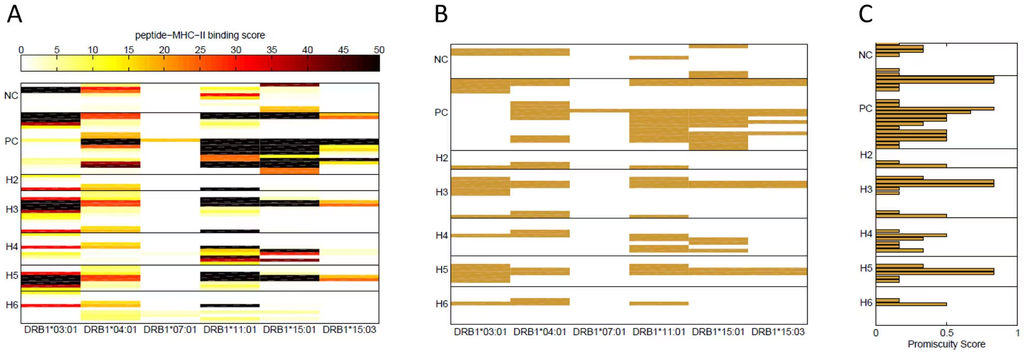
米国FDAの研究者らによって公表されたProImmune REVEAL®のデータ
ProImmune REVEAL®は、がんや感染症のあらゆる領域を含む、多くの疾患領域で幅広く応用可能です。この技術を用いて同定された新たなCD4+およびCD8+ T細胞エピトープは、タンパク質の抗原性の評価や、ワクチン開発の基盤となる構成要素、あるいは新たな免疫療法の標的として活用することができます。
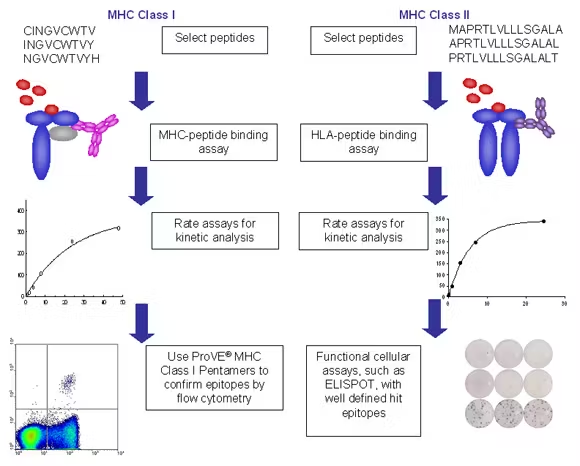
- いずれの場合も、ProImmune社の汎用性の高い「thinkpeptides」ペプチド合成プラットフォームに基づき、各プロジェクトに合わせてペプチドが合成されます。使用されるペプチドは、重複配列由来のものであれ、個別に選定されたペプチドであれ、あらゆる適切な形態のものとなります。
- その後、各ペプチドを組換えMHC分子とインキュベートし、免疫測定法を用いてMHC-ペプチド複合体の安定化を測定する。
- 結合および解離は、各ケースにおいて単一の時間間隔でハイスループットに測定できるため、多くの対立遺伝子やペプチドを並行して、かつ手頃なコストでスクリーニングすることが可能である。
- あるいは、特に興味深いペプチドについては、フォローアップとして、より詳細な結合速度および解離速度の特性を明らかにするために、より詳細な速度測定を行うことも可能です。
- エピトープの検証は、MHCクラスI用のProVE®ペンタマーやMHCクラスII用のProT2®テトラマーといったMHCマルチマーを用いて行うことができます。あるいは、MHCマルチマー技術に代わる方法として、またはそれらと組み合わせて、ELISpot、細胞内サイトカイン染色のフローサイトメトリー解析、増殖アッセイなどの機能アッセイを実施し、特定のペプチドについて機能的な確認を行うことも可能です。
この短い(22秒)体験談では、全南国立大学のチェ・ユンジュ教授が、ProImmune社と共同でREVEAL® MHC-ペプチド結合アッセイを用いて、T細胞エピトープの削除によるタンパク質の脱免疫
論文ピックアップ
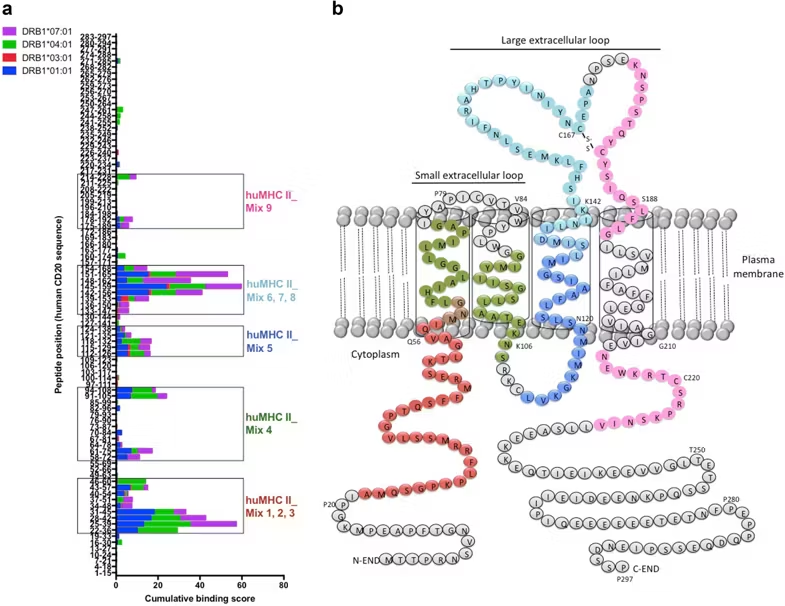
リンパ腫の免疫療法に関連する新規のCD20特異的CD4+ T細胞エピトープを同定するために
Milcent B., Siberil S. et al, (2019), “Presence of T cells directed against CD20-derived peptides in healthy individuals and lymphoma patients” Scientific Reports (2019),Vol. 9, Art.No. 10165
Cancer Immunology, Immunotherapy
要約:
前臨床および臨床研究により、抗腫瘍抗体を用いたがん治療が、特異的な適応性T細胞応答を誘導することが示唆されている。この過程において、CD4+ T細胞が中心的な役割を果たしていると考えられている。本研究では、HLA-DR1、HLA-DR3、HLA-DR4、およびHLA-DR7によって制限されるヒトCD20由来のエピトープを同定した。
本研究の結果は、慎重に選択されたCD20由来のMHC II制限性ペプチドにより、ヒト化HLA-DRトランスジェニックマウスおよびヒト末梢血単核細胞(PBMC)において、CD20特異的なCD4+ T細胞応答を誘導できることを示している。これらのペプチドは、B細胞悪性腫瘍における治療ツールとして、ワクチン接種戦略の文脈においてCD8+ T細胞応答を助長し、最終的には直接的な細胞傷害性エフェクター機能を通じて、CD4+ T細胞の抗腫瘍活性を向上させる役割を果たし得る。
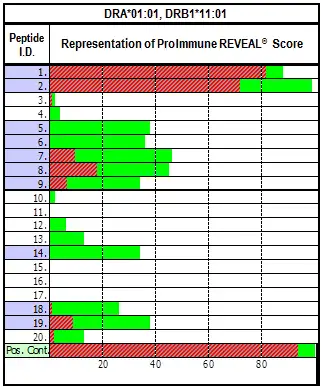
プロジェクトの報告
ProImmune REVEAL® のデータは、このアッセイ範囲向けの詳細なレポートテンプレートに記載されています。レポートには、選択された特定のアッセイからのデータが掲載されています。
ProImmune REVEAL® 利用可能なMHC対立遺伝子
| HLAクラスIA*01:01A*02:01A*03:01A*11:01A*24:02A*29:02B*07:02B*08:01B*14:02B*15:01B*27:05B*35:01B*40:01C*03:04C*04:01C*06:02C*07:01C*07:02C*08:01E*01:01クラスI:H-2KbDbLdKdDd第1類:マムA*01A*02 | クラスII:HLA DRA1*01:01/B1*01:01A1*01:01/B1*15:01A1*01:01/B1*03:01A1*01:01/B1*04:01A1*01:01/B1*11:01A1*01:01/B1*13:01A1*01/01・B1*07/01A1*01:01/B1*01:02A1*01:01/B1*04:02A1*01:01 /B1*04:04A1*01:01/B1*04:05A1*01:01/B1*04:07A1*01:01 / B1*04:08A1*01:01/B1*08:04A1*01:01/B1*09:01A1*01:01/B1*10:01A1*01:01/B1*11:02A1*01:01/B1*11:03A1*01:01/B1*11:04A1*01:01/B1*15:02A1*01:01/B1*15:03A1*01:01/B1*16:01A1*01:01/B1*16:02A1*01:01/B3*02:02A1*01:01/B3*03:01A1*01:01/B5*01:01クラスII:H-2IAbIAd | II型:HLA DQA1*01:01/B1*05:01A1*05:01/B1*03:01A1*01:02/B1*05:02A1*01:02/B1*06:02A1*03:01/B1*03:02A1*01:02/B1*06:04A1*02:01/B1*02:02A1*03:01/B1*03:01クラスII:HLA DPA1*01:03/B1*01:01A1*01:03/B1*02:01A1*01:03/B1*03:01A1*01:03/B1*04:01A1*01:03/B1*04:02A1*01:03/B1*05:01A1*02:01/B1*01:01A1*02:01/B1*02:01A1*02:01/B1*03:01A1*02:01/B1*04:01A1*02:01/B1*04:02A1*02:01/B1*05:01A1*02:01/B1*06:01A1*02:01/B1*09:01A1*02:01/B1*11:01A1*02:01/B1*13:01A1*02:01/B1*14:01A1*02:01/B1*15:01A1*02:01/B1*17:01A1*02:02/B1*05:01 |
レミケード®に関するProImmune REVEAL®の高スループットデータ
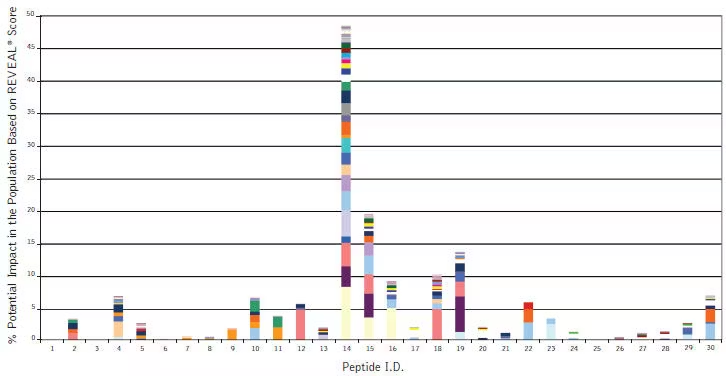
ProImmune REVEAL® の用途
- 迅速かつ包括的なエピトープマッピングにより、MHC結合の制限を実験的に解明する。
- タンパク質の異なる変異体の免疫原性に関する研究。例えば、あるウイルスの異なる系統における免疫原性タンパク質の可変領域と保存領域の比較など。
- 臨床モニタリングの最適化。例えば、対象患者群のモニタリングに最適なペンタマーの特異性の選定など。
- 複数の対立遺伝子によるペプチドの交差提示の同定
- ワクチンの設計と有効性の向上。
- 突然変異導入研究:部分的または弱いアンカーしか持たないペプチド配列へのアンカー残基の挿入など、治療用途に向けたエピトープ結合の最適化
知的財産権の立場の強化
治療用タンパク質やその他の対象となるタンパク質の個々のエピトープを特定することで、そのタンパク質に関する知的財産(IP)を、送達方法やその治療用途に関するIPから分離することが可能になります。 ワクチン開発において、特定のエピトープに関するIPを明確に定義しておくことで、将来的な製品設計の変更に向けた選択肢が広がります。対象となるタンパク質に含まれる特定の抗原に関するIPを確保していない場合、競合他社が妨害的な特許ポジションを構築する機会を与えてしまう可能性があります。
事例研究:
HIV-1における新規T細胞エピトープの同定に用いられるProImmune REVEAL®およびProVE®迅速エピトープ発見システム
Westrop, S.J. et al. (2009). “Novel approach to recognition of predicted HIV-1 Gag B*35:01-restricted CD8 T-cell epitopes by HLA-B*35:01+ patients: Confirmation by quantitative ELISpot analyses and characterisation using multimers.” J Immunol Methods. 341: 76-85. [PubMedID: 19056394]
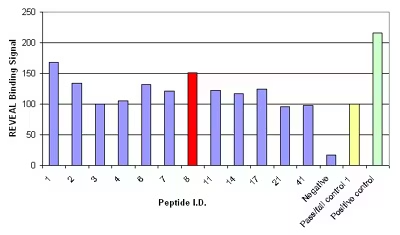
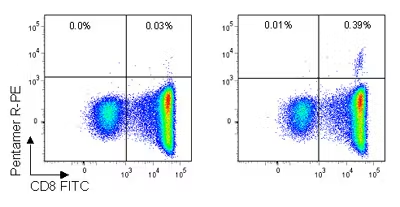
著者は、本研究について「ProImmuneという新しい技術が、潜在的な免疫原性エピトープを特定するための有用かつ優れたツールであることを裏付けるものである」と述べ、また、ELISpotやPro5®ペンタマー染色などの機能アッセイを用いて、結果を並行して検証することの重要性を強調した。
バクスター社が、ProImmune REVEAL® 結合アッセイを用いて、ヒト第VIII因子治療薬の免疫原性を解明
Steinitz, K. et al . “CD4+ T-cell epitopes associated with antibody responses after intravenously and subcutaneously applied human FVIII in humanized hemophilic E17 HLA-DRB1*15:01 mice.” Blood (2012) [PubMedID:22394599]
文献リスト
Ahmed, SS. et al. (2015) Antibodies to influenza nucleoprotein cross-react with human hypocretin receptor 2. Science Translational Medicine. 7(294). [PubMedID: 26136476]
Bell, MJ. et al. (2009) The peptide length specificity of some HLA class I alleles is very broad and includes peptides of up to 25 amino acids in length. Mol Immunol. 46: 1911-1917[PubMedID: 19157553]
Berinstein, N.L. et al (2012) First-in-man application of a novel therapeutic cancer vaccine formulation with the capacity to induce multi-functional T cell responses in ovarian, breast and prostate cancer patients. Journal of Translational Medicine. 10(1):156. [PubMedID: 22862954]
Blancou, P. et al. (2007). Immunization of HLA Class I transgenic mice identifies autoantigenic epitopes eliciting dominant responses in type 1 diabetes patients. J. Immunol. 178: 7458-7466. [PubMedID: 17513797]
Burlingham, W. et al (2013). Epitope analysis of the collagen type V-specific T cell response in lung transplantation reveals an HLA-DRB1*15 bias in both recipient and donor. PLoS One 8(11). [PubMedID: 24265781]
Burrows, J.M. et al (2007). The impact of HLA-B micropolymorphism outside primary peptide anchor pockets on the CTL response to CMV. Eur. J. Immunol. 37: 946-953. [PubMedID: 17357107].
Bui et al (2010) Mutation-specific control of BCR-ABL T315I positive leukemia with a recombinant yeast-based therapeutic vaccine in a murine model. Vaccine 28:6028 [PubMedID: 20619375]
Dang et al (2011) Human type 1 diabetes is associated with T cell autoimmunity to zinc transporter 8. Journal of Immunology 186:6063 [PubMedID: 21471440]
Freed et al (2011) Association of the HLA-DRB1 epitope LA(67, 74) with rheumatoid arthritis and citrullinated vimentin binding. Arthritis Rheumatism 63:3733 [PubMedID: 22094856]
Gerstner, C. et al (2016). Functional and Structural Characterization of a Novel HLA-DRB1*04:01-Restricted alpha-Enolase T Cell Epitope in Rheumatoid Arthritis. Frontiers in Immunology. (doi: 10.3389/fimmu.2016.00494/full)
Gomez-Tourino, I. et al (2015). Characterization of the autoimmune response against the nerve tissue S100β in patients with type 1 diabetes. Clinical and Experimental Immunology. 180(2): 207-17. [PubMedID: 25516468]
Harrop, R. et al (2008). Vaccination of colorectal cancer patients with TroVax given alongside chemotherapy (5-fluorouracil, leukovorin and irinotecan) is safe and induces potent immune responses. Cancer Immunol. Immunother. 57: 977-86. [PubMedID: 18060404] Read Case Study
Keller et al (2013). Epitope analysis of the collagen type V-specific T cell response in lung transplantation reveals an HLA-DRB1*15 bias in both recipient and donor. PLoS One 8(11): e79601.
Lepone et al (2010) Monofunctional and polyfunctional CD8+ T cell responses to human herpesvirus 8 lytic and latency proteins. Clinical and Vaccine Immunology 17:1507 [PubMedID: 20719985] Read Case Study
Liu et al (2014) Preliminary exploration of HLA-A*1101-restricted human cytomegalovirus glycoprotein B-specific CD8+ T cells in allogeneic stem-cell transplant recipients. Virus Research. 188:38, pp.38-44.[PubmedID: 24704672]
MacNamara, A et al (2010). HLA Class I Binding of HBZ Determines Outcome in HTLV-1 Infection. PLoS Pathogens 6: e1001117 [PubMedID: 20886101]
Milcent, B. et al (2019) Presence of T cells directied against CD20-derived peptides in healthy individuals and lymphoma patients. Cancer Immunol Immunother 68: 1561 [PubMedID: 31494742]
Muixi, L. et al (2008). Thyroglobulin peptides associate in vivo to HLA-DR in autoimmune thyroid glands. J Immunol. 181: 795-807 [PubMedID: 18566446] Read Case Study
Ofran et al (2010) Diverse patterns of T-cell response against multiple newly identified human Y chromosome-encoded minor histocompatibility epitopes. Clinical Cancer Research 16:1642 [PubMedID: 20160060]
Oliveira, A. et al (2009). High Frequencies of functionally competent circulating Tax-specific CD8+ T cells in human T lymphotropic virus type 2 (HTLV-2) infection. J Immunol. 183: 2597-2965 [PubMedID: 19657093]Read Case Study
Pandey et al (2013). Polymorphisms in the F8 Gene and MHC-II Variants as Risk Factors for the Development of Inhibitory Anti- Factor VIII Antibodies during the Treatment of Hemophilia A: A Computational Assessment. PLoS Computational Biology 9(5): e1003066. [PubMed ID: 23696725]
Pieper et al (2012) α-enolase specific T cells in rheumatoid arthritis – a MHC class II tetramer approach Annals of the Rheumatic Diseases 71:A33
Ramaswami, B. et al (2009) HLA-A01, -A03 and -A024 binding nanomeric epitopes in polyomavirus BK large T-antigen. Human Immunology. doi: 10.1016/j.humimm.2009.05.003 [PubMedID: 19446588]
Ramesh, M. et al (2016) Peanut T-cell epitope discovery: Ara h 1. The Journal of Allergy and Clinical Immunology. 137(6): 1764-1771. [PubMedID: 26953158]
Robey et al (2011) Ex-vivo recognition of late-lytic CD8 epitopes specific for Kaposi’s sarcoma-associated herpesvirus (KSHV) by HIV/KSHV-coinfected individuals.. Viral Immunology 24:211 [PubmedID: 21668362]
Scotto et al (2012) Zinc transporter (ZnT)8186–194 is an immunodominant CD8+ T cell epitope in HLA-A2+ type 1 diabetic patients Diabetologica [PubMedID: 22526607]
Steeter, HB. et al (2015) Preclinical development and first-in-human study of ATX-MS-1467 for immunotherapy of MS. Neurology, Neuroimmunology & Neuroinflammation. 2(3). [PubMedID: 25798453]
Steinitz K. et al (2012) CD4+ T-cell epitopes associated with antibody responses after intravenously and subcutaneously applied human FVIII in humanized hemophilic E17 HLA-DRB1*1501 mice. Blood (in press)[PubmedID: 22394599] Read Case Study
van der Heiden, P. et al (2009). Identification of Varicella Zoster Virus specific CD8 T cells in patients after T cell depleted allogeneic stem cell transplantation. J. Virol. 83: 7361-7364. [PubMedID: 19386715] Read Case Study
Weiskopf, D. et al (2009). Oxidative stress can alter the antigenicity of immunodominant peptides. J. Leukoc. Biol. 87: epub ahead of print. [PubMedID: 19801502] Read Case Study
Westrop, S. et al (2009). Novel approach to recognition of predicted HIV-1 Gag B*3501-restricted CD8 T-cell epitopes by B*3501+ patients: Confirmation by quantitative ELISPOT analyses and char